While many scholars (particularly now-tenured, though some non-tenured too) have taken to blogging and social media lately (the movement seems to have exploded in 2011 and 2012, with many academic conferences having their own Twitter hashtag – check the American Anthropology Association, the MLA and the upcoming American Association of Geographers 2012 hashtags), I have experimented with social media since 2006 (though, at the time, it was purely for personal use). I have been using social media in my teaching and my own research extensively since 2009, and I’m glad that my fellow academics are now embracing it as a tool to build new collaborative research networks. That’s the purpose of the #MyResearch hashtag.
Fellow academics: please tweet a summary of your research interest. Hashtag #myResearch and please RT widely #phdchat thanks!
— Dr Raul Pacheco-Vega (@raulpacheco) January 13, 2012
As a way to provide context, let me summarize a bit of my academic history. When I was a PhD student, I built my scholarly networks the old-fashioned way. I emailed senior professors all over the world, I kept constant contact via email, I joined list-servs and participated in scholarly conversations in these forums. I then would attend conferences and meet the folks I had emailed and/or had discussions with over the list-serv and talk “in real life”. This meant that it took YEARS to build the kind of robust, strong collaboration networks I have built. With social media, the ability to create collaborative networks, and advance knowledge translation and knowledge mobilization strategies is much enhanced. The recent (early) success of the #MyResearch hashtag in spreading throughout the world appears to confirm my suspicions: that social media can (and SHOULD) be used to advance scholarly research and improve the way in which we academics liaise with the world that will eventually use our findings.
A few months ago, I attempted to showcase to my students and colleagues how Twitter could be used to spread the word about my (and other scholars’) research findings. At that time, it didn’t really take off. This time (and for reasons that probably warrant research itself), it did, and as you can tell from this visualization created by Marc Smith (thanks to Ines Mergel for connecting me with Marc, via Twitter no less), there have already been emerging some interesting conversational patterns.
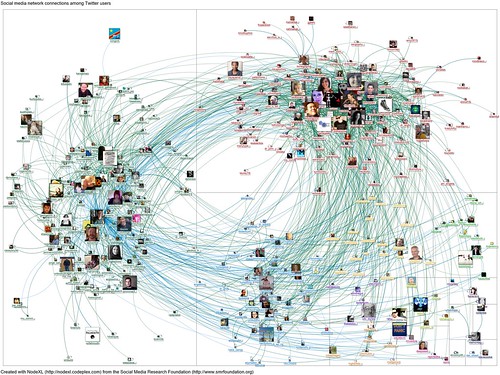
Thanks to everyone who has retweeted my plea to summarize your research findings. A number of scholars (yes, I’ve read your tweets) seem to be skeptical about people wanting to broadcast their plans for a research grant (the closed view of the world in academia where you need to be FIRST to publish something probably needs some expansion). I don’t think that any scholar needs to post exactly what they are planning to do, but for those of you who are interested, there’s a whole stream of thought called Open Research (and Open Science).
I would like to encourage folks to continue to share your research findings via the #MyResearch hashtag. I have seen early signs of beginnings of collaboration among Twitter users and I’m excited by what may come from this.

As a professional social media strategist, specializing in helping researchers tell their story (knowledge translation and exchange (KT) and knowledge mobilization (KMb)), I am a huge supporter of the power of social connections – in whatever form that may take.
Face-to-face, email, phone, conference connections and many other traditional networking forms are still valuable. They are, however, enhanced with the strategic use of social media. It is truly about making the connections that matter and forming relationships of value. No longer are we locked into building relationships with colleagues in our own geographic area. The geographical boundaries no longer pose an issue. We now have the power to connect with anyone, in any location across the globe. This is very powerful to those of us who have stories to tell.
Can you connect with funders on Twitter? Yes. Can you connect with policy makers on Facebook? Yes. Can you show your research in action via Foursquare? Yes. Can you reach your career and research goals by incorporating these tools, and many more, into your activities. YES, YES, and YES!
We live in an increasingly networked world that allows us the benefit of connections with no barriers. With this power comes great responsibility. We must be keenly aware of the image we are portraying and maintain that image across various social platforms and communication opportunities. This is where people like me come in. We know the power of the tools and how to put them work for you.